
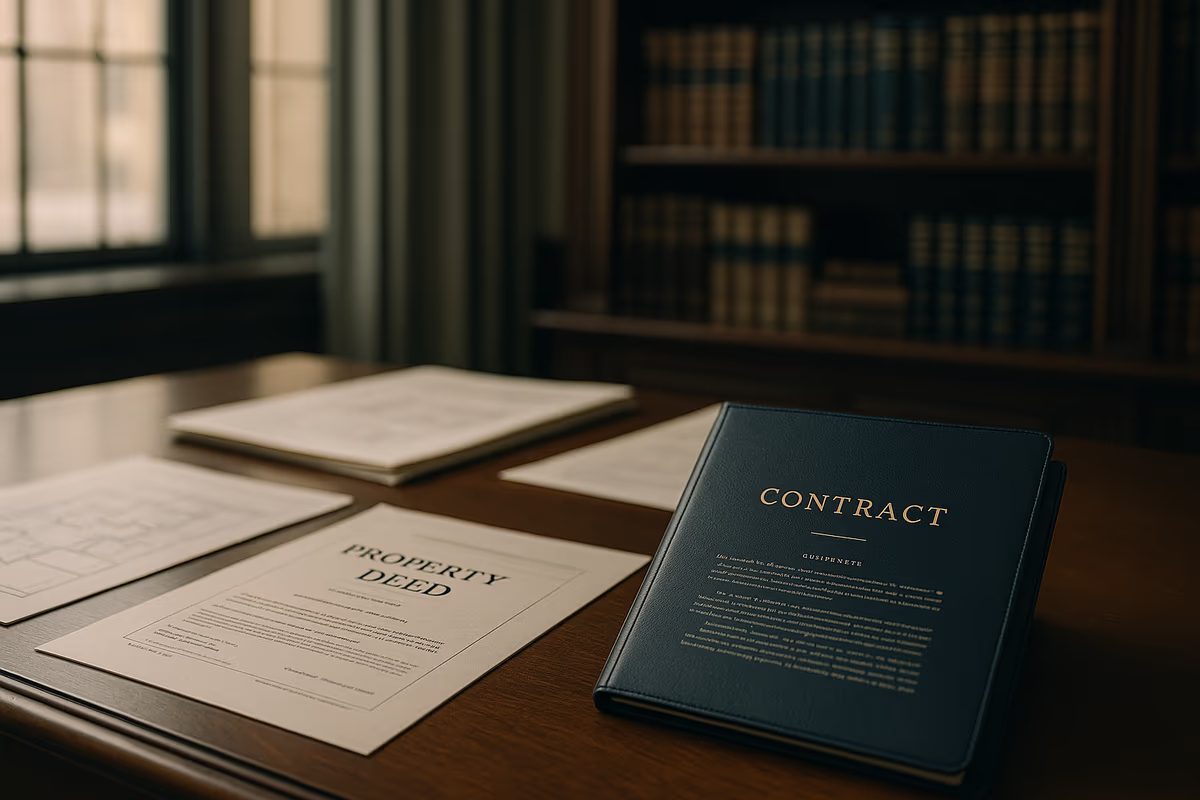

Buying a property is often the largest investment of a lifetime. Between the excitement of discovering a home and the urgency imposed by competition, drafting the purchase offer becomes a delicate exercise that binds the buyer legally and financially. A poorly drafted offer can lead to costly disappointments or to the loss of an opportunity. This guide sets out each component of a structured and secure property purchase offer, the essential clauses and the pitfalls to avoid in order to negotiate with confidence.
The legal fundamentals of the purchase offer
Legal nature and scope of the commitment
A property purchase offer is a pollicitation (a unilateral offer to contract) within the meaning of Article 1114 of the French Civil Code. From the moment it is handed to the seller, it legally binds the person making it for the period it specifies, generally 7 to 15 days. This validity period protects the seller against an untimely withdrawal by the buyer, while leaving a reasonable time to consider the proposal.
The seller's unqualified acceptance of the offer forms a preliminary sale agreement (avant-contrat). At that stage, the transaction becomes irrevocable for both parties, subject to any conditions precedent stipulated. The contract is formed as soon as there is agreement on the property and the price, in accordance with Article 1583 of the French Civil Code.
Distinction from the unilateral promise to sell
A purchase offer is fundamentally different from a unilateral promise to sell (promesse de vente). In a purchase offer, the buyer takes the initiative and undertakes to buy if the seller accepts. In a promise to sell, the owner undertakes to sell and reserves the property for a set period, generally in return for payment of an immobilisation indemnity by the beneficiary buyer. The content of this preliminary agreement is presented in our article on the essential clauses to include in a promise to sell.
This legal nuance has important practical consequences. A purchase offer allows the buyer to keep the initiative in the negotiation and to avoid paying a substantial sum immediately, unlike a promise to sell, which often requires an indemnity of 5 to 10% of the sale price.
Structure and content of a complete purchase offer
Precise identification of the parties and the property
Drafting begins with the full identification of the parties. For the buyer, state the surname, first names, date and place of birth, occupation, home address and marital status. Where a couple is buying, state the matrimonial property regime and the intention to buy in joint ownership (indivision), by tontine (a survivorship clause) or under another arrangement.
The description of the property must reproduce exactly the land registry details: commune, section, plot number, area according to the land registry. For an apartment, add the floor, the Carrez area (the legally measured floor area), the number of rooms and any ancillary areas (cellar, parking space, attic). This precision avoids any ambiguity at final signature.
Include a reference to the mandatory technical surveys: energy performance diagnostic (DPE), asbestos report, lead exposure risk report, report on the condition of the internal electricity and gas installations if the installations are more than 15 years old, and a termite report in a contaminated zone.
Price and payment terms
Stating the price is an essential element of the validity of the offer. Word it clearly: "I, the undersigned [name], offer to buy the property described above at the price of [amount in figures] euros ([amount in words] euros)."
Specify the payment terms: personal contribution, amount of the planned mortgage, and the lender in view. This transparency reassures the seller about the financial feasibility of the transaction and strengthens the credibility of the offer.
If the offer is below the asking price, justify the difference by objective factors: necessary works identified during the viewing, recent sale prices in the building or the neighbourhood, and particular features of the property (orientation, floor, overlooking). This reasoning facilitates the negotiation.
Essential conditions precedent
Condition precedent of obtaining a loan
The condition precedent of obtaining credit protects the buyer against the risk of financing being refused. Draft it precisely:
"This offer is subject to the buyer obtaining a loan of [amount] euros, at an overall effective rate not exceeding [rate]%, repayable over a period not exceeding [term] years, from a credit institution of the buyer's choice."
Set a reasonable period for obtaining approval in principle, generally 45 days from signature of the preliminary agreement. This period allows the application to be processed without delaying the sale excessively.
Condition precedent relating to easements and town planning
For a house, include a condition precedent relating to obtaining an operational planning certificate (certificat d'urbanisme opérationnel) if extension or alteration works are planned. This precaution avoids unpleasant surprises arising from local planning rules.
Add a condition relating to the absence of undeclared easements (servitudes) liable to burden the use of the property: "This sale is conditional on the absence of rights of way, rights of light or view, or other easements, not mentioned in the documents provided, that would impair the normal use of the property."
Price revision clauses
Taking account of works discovered
A revision clause may provide for a reduction in the price if works that were not apparent during the viewing are discovered. Word it as follows:
"If defects that were not apparent during the viewing (structural problems, defective installations requiring upgrading to standard) are discovered before final signature, the price may be revised downwards by the cost of the works, on presentation of quotations from qualified contractors."
This clause must remain reasonable. Courts are reluctant to allow revisions for minor defects or defects that a diligent buyer could have foreseen.
Time-based indexation clause
If final signature takes place several months after the offer (time taken to process the loan, vacation of the property by tenants), an indexation clause may protect the seller against property price inflation:
"If the notarial deed is signed more than [number] months after acceptance of this offer, the price will be revised in line with the movement in the index of prices of existing property published by INSEE, up to a maximum increase of [percentage]%."
Negotiation and practical arrangements
Offer strategy in a tight market
In a competitive property market, the purchase offer becomes an exercise in strategic positioning. In high-demand areas (city centres, inner suburbs of Paris), offering the asking price straight away may be necessary to avoid a bidding war with other buyers.
The time factor then becomes important: ability to sign quickly, absence of a chain, financing already pre-approved. Emphasise these differentiating elements to compensate for an offer that is not the highest.
Consider ancillary costs in your strategy. Offering to bear costs normally borne by the seller (an additional survey, the cost of releasing a mortgage) can make the difference without substantially increasing your overall budget.
Time limits and formalities for validity
Set a realistic validity period for your offer: 7 working days is a standard period that gives the seller time to reflect without exposing you for too long. In periods of strong demand, reduce it to 48 or 72 hours to create a legitimate sense of urgency.
Specify how the offer is to be delivered: hand delivery against a receipt, registered post with acknowledgement of receipt, or transmission through the notary or the estate agent. The date and time of receipt determine the starting point of the validity period.
State explicitly that the offer lapses if there is no reply within the set period, and that it can be accepted only in full, without any change to the conditions proposed.
Handling counter-proposals
Faced with a counter-proposal from the seller (different price, amended conditions), your initial offer lapses. You regain your freedom to commit and must make a new offer if the terms proposed suit you.
Analyse each change methodically: a price increase may be acceptable if it comes with a shorter period for vacating the property or the seller bearing certain costs. Quantify the overall impact of these adjustments before accepting.
Never feel obliged to accept a counter-proposal. A seller who makes a counter-proposal implicitly reveals an interest in your profile as a buyer, which strengthens your negotiating position for a slightly revised new offer.
Specific clauses according to the type of property
Buying an apartment in a co-ownership building
For an apartment, include clauses specific to the co-ownership regime (copropriété). Ask for the minutes of the last three general meetings and the accounts of the co-ownership. Stipulate a condition precedent relating to the absence of voted works for which no provision has been made, exceeding an amount that you set.
The clause may be worded as follows: "The sale is subject to there being no works voted at a general meeting and not yet carried out, of an individual amount exceeding [amount] euros or a cumulative amount exceeding [amount] euros, for the buyer."
Check whether there is a works fund under Article 14-2 of the Law of 10 July 1965, which is mandatory for co-ownerships of more than 5 units used for housing, offices or shops. Its absence may reveal poor management or signal significant calls for funds.
House with land
Buying a house with land calls for particular checks. Include a condition precedent relating to compliance of the private drainage system if the house is not connected to the mains sewer. Periodic inspection of the installation is mandatory and costly upgrading to standard may be required.
Check whether there is a recent boundary survey agreed between neighbours (bornage contradictoire), less than 10 years old. If there is none, stipulate that the sale will be conditional on a boundary survey being carried out at the seller's expense, or negotiate a split of the costs.
For recent buildings, ask for the ten-year and two-year guarantees, and the certificates of construction-damage insurance (assurance dommages-ouvrage). These documents determine your recourse in the event of future defects.
Investment building or commercial premises
Buying an investment building (immeuble de rapport) involves analysing the existing leases. Ask for all lease agreements, condition reports, security deposits and recent rent receipts. Check that rent reviews have been regular and that there are no disputes with tenants.
Calculate gross and net yield precisely, taking into account all non-recoverable charges, provisions for works and foreseeable vacancy. A condition precedent may make the sale conditional on a minimum level of yield: "The sale is subject to evidence of an annual net yield of at least [percentage]% calculated on the purchase price."
Legal security and professional support
Role of the notary in validation
Although a purchase offer can be drafted without notarial involvement, having your project validated by a notary before signing makes the transaction considerably more secure. The notary checks the legal consistency of the clauses, their compatibility with the regulations in force and their balance.
This preventive consultation, charged at around 200 to 300 euros, avoids later disputes and optimises the drafting of the conditions precedent. The notary can also carry out preliminary checks on the mortgage position of the property and the absence of any objections.
Involvement of the estate agent
The estate agent often acts as an intermediary in passing on and negotiating the offer. Check that the agent holds a proper sale mandate and does not exceed his or her powers by changing the terms of your offer.
Require a detailed receipt when you submit your offer, stating the exact conditions and the validity period. The agent cannot accept the offer on behalf of the seller without a specific mandate to that effect.
Putting together the financing file
Plan ahead for putting together your loan application as soon as you make the offer. Gather recent supporting documents: payslips for the last three months, tax assessment notices, account statements for the last three months, and evidence of your personal contribution.
This advance preparation speeds up processing of the application once the offer is accepted and reduces the risk of failure linked to the time limit in the financing condition precedent. Some institutions issue prior financing certificates that strengthen the credibility of your offer.
Common mistakes to avoid
Underestimating ancillary costs
The most common mistake is to underestimate the ancillary costs of purchase. To the notary's fees (7 to 8% of the price for existing property, 2 to 3% for new property), add agency fees if they are payable by the buyer, bank arrangement fees, borrower insurance, and guarantee or surety fees.
These costs easily represent 10 to 12% of the purchase price for existing property. Include them in your financing plan to avoid difficulties at final signature.
Neglecting the technical surveys
The technical surveys provided at the viewing are contractual documents. Examine the DPE carefully: an energy rating of F or G signals high heating bills and possible insulation works. The electrical survey may reveal an installation that has to be completely redone.
A positive asbestos report does not prevent the sale but requires particular precautions in the event of future works. Always work out the financial consequences of these surveys before setting your price offer.
Rushing the signature
The time pressure of the property market sometimes pushes buyers to rush. Always take the time to re-read your offer in full before signing and to check every element: spelling of names, accuracy of amounts, consistency of time limits.
A poorly drafted purchase offer can lead to costly disputes or to the loss of the sale. Speed must never take precedence over legal precision.
After acceptance: steps to the final sale
Formalising the preliminary agreement
The seller's acceptance of your offer forms a preliminary sale agreement that definitively binds the parties. Within 15 days of that agreement, a detailed compromis de vente (preliminary sale agreement) or promise to sell should generally be signed at the notary's office to formalise the final conditions. The steps and precautions for this signing are set out in our complete guide to signing the compromis de vente in 2026.
This stage makes it possible to specify the practical arrangements: allocation of costs, date of final signature, arrangements for vacating the property, and apportionment of co-ownership charges for the current year.
Activating the conditions precedent
As soon as the preliminary agreement is signed, start the search for financing immediately if you do not yet have approval in principle. Submit your application to several institutions to optimise your credit terms and secure the loan.
Also carry out all the checks provided for by the conditions precedent: application for a planning certificate, consultation of the municipal archives for easements, and additional technical checks if necessary.
Preparing the final deed
The weeks before final signature are used to finalise all the practical aspects: putting the meters in your name, taking out the compulsory home insurance, and organising the move.
The notary prepares the notarial deed of sale and carries out the last regulatory checks: updated mortgage position, certificate of no attachment, and calculations of the apportionment of charges and taxes.
Drafting an effective property purchase offer combines legal rigour and commercial strategy. Each clause must serve a precise purpose: legally securing the buyer, facilitating the negotiation or optimising the financial conditions. Investing in careful drafting and, where appropriate, in the assistance of a legal professional provides lasting protection against the uncertainties of a property transaction. Before signing anything, always have your offer reviewed by a notary or a lawyer who practises property law to confirm its consistency and its enforceability.
Frequently asked questions
Can a purchase offer be withdrawn before the seller accepts it?
Yes, a purchase offer can be withdrawn as long as it has not been accepted by the seller, even during the stated validity period. The withdrawal must be notified to the seller in writing before the seller has shown acceptance. Note that this rule does not apply if the offer contains a clause making it irrevocable during the stated period.
Does a purchase offer immediately commit the buyer to payment?
No, a purchase offer does not commit the buyer to immediate payment of large sums. It may provide for payment of a deposit (generally 5 to 10% of the price) only on signature of the preliminary agreement that will formalise acceptance. This deposit is then deducted from the price on the final sale. The regime of this sum, from its amount to its fate if the buyer withdraws, is covered in our guide to the deposit on a property purchase.
What happens if the loan condition precedent is not satisfied?
If the buyer does not obtain the loan within the periods and on the terms provided for by the condition precedent, the sale is automatically cancelled without penalty. The buyer recovers in full the sums paid as a deposit. The buyer must, however, show that diligent applications were made to lenders in order to benefit from this protection.
Can a purchase offer be changed after it has been handed to the seller?
Once handed over, a purchase offer can no longer be changed unilaterally by the buyer. Any change amounts to a new offer that cancels and replaces the previous one. The seller may, however, make a counter-proposal, which releases the buyer from the initial commitment and allows the buyer to make a revised offer.
How long should be allowed between the purchase offer and final signature?
The usual period is 2 to 4 months between acceptance of the offer and signature at the notary's office. This period covers processing of the loan application (45 to 60 days), preparation of the notarial deed (15 to 30 days) and any vacation of the property by the seller. In the case of a chain or a complex file, allow up to 6 months.
Is it compulsory to involve a notary to draft a purchase offer?
Notarial involvement is not compulsory for drafting a purchase offer, unlike the final deed of sale. However, having your project validated by a notary before signing makes the transaction legally more secure and optimises the drafting of the conditions precedent, for a consultation fee of 200 to 300 euros.
Can several purchase offers be made at the same time on different properties?
Technically, nothing prevents making several purchase offers at the same time, but the practice carries risks. If several sellers accept at the same time, the buyer is committed to several transactions and will have to bear the financial consequences of withdrawals. It is more prudent to stagger the offers or to provide for very short validity periods.
Quatre questions suffisent à situer votre position, le délai qui vous reste et ce qu'il faut vérifier en priorité. Vous décidez ensuite si vous en parlez au cabinet.
Décrire ma situationA defect discovered after the sale?
The time limit for taking action runs not from the sale but from the discovery of the defect, and it is shorter than people think.


