
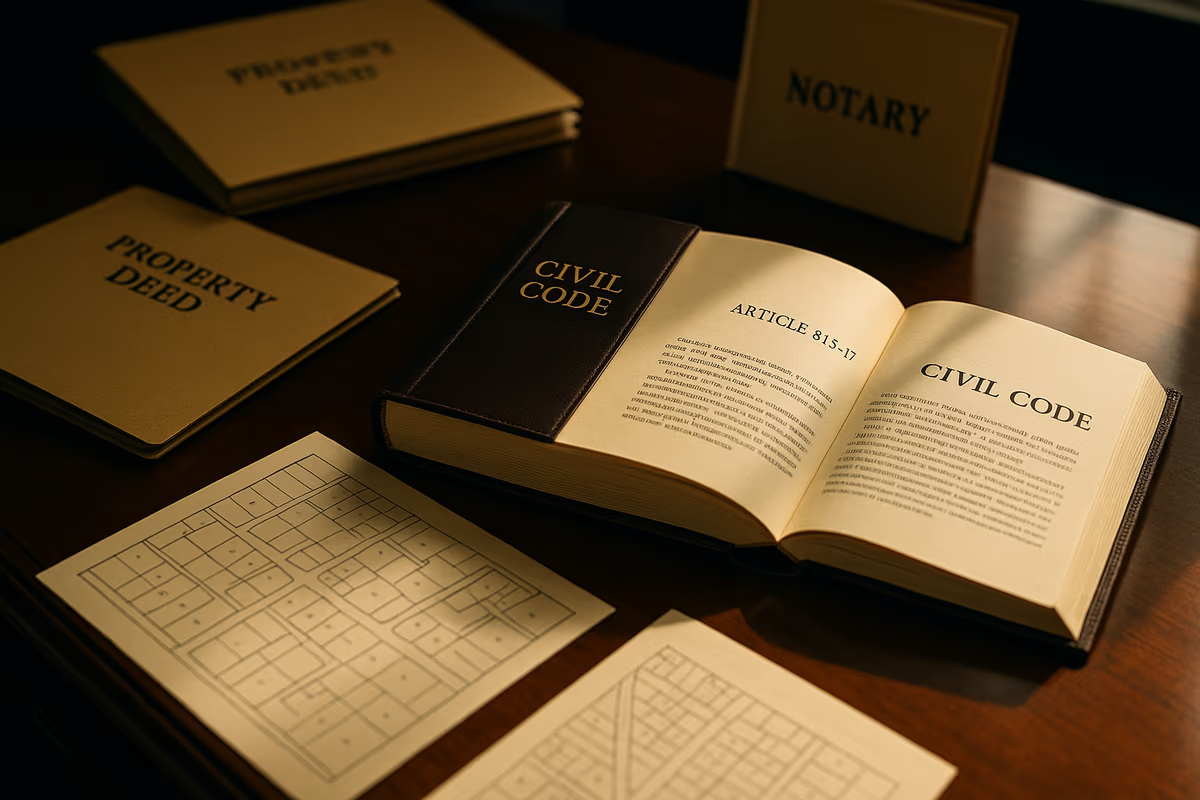

A creditor obtains a judgment ordering its debtor to pay a substantial sum. It carries out the usual searches and finds that the debtor's only asset of value is a share in a house received by inheritance, held in joint ownership (indivision) with two brothers and sisters. First reaction: have that share seized and sold at auction. The wrong approach. Article 815-17 of the French Civil Code precisely prohibits such direct seizure and requires a detour, the action for partition. This guide explains what a creditor can really seize in jointly owned property, why the undivided share escapes ordinary seizure, and how to bring about partition in order to be paid.
Two categories of creditor, two opposite regimes
Any analysis starts with a distinction that Article 815-17 of the French Civil Code makes in its opening lines. Faced with jointly owned property, French law does not treat two types of creditor in the same way, and confusing them leads to void proceedings.
The creditor of the joint ownership has a claim that concerns the joint ownership itself. Article 815-17, paragraph 1, covers two situations. First, creditors who could have taken action against the property before the joint ownership arose, for example the bank holding a mortgage taken over the building during the deceased's lifetime, before the estate placed the property in joint ownership among the heirs. Second, creditors whose claim arises from the preservation or management of the jointly owned property, for example the contractor who carried out urgent roofing works on the common building, or the property manager (syndic) who is owed co-ownership charges (copropriété) relating to the jointly owned unit.
These creditors shall be paid by deduction from the assets before partition. They may in addition pursue seizure and sale of the jointly owned property. (Article 815-17, paragraph 1, of the French Civil Code)
In other words, the creditor of the joint ownership can seize and sell the whole of the jointly owned property, without waiting for partition and without bringing it about. Its position is an enviable one.
The personal creditor of a joint owner is in a quite different position. Its claim arose against one person only, one of the joint owners (indivisaires), for a reason unrelated to the joint ownership: a consumer loan, a business debt, maintenance, a bank account balance, an award of damages. That creditor has no rights against the other joint owners or against the jointly owned property itself. It is to this creditor that the restrictive regime of Article 815-17, paragraphs 2 and 3, applies, which is the heart of this guide.
An example to fix ideas
Three children inherit the family home, which they now hold in joint ownership in equal shares. One of them, the manager of a small joinery business, owes a substantial sum to a timber supplier that has obtained a judgment against him or her. That supplier is a personal creditor of the joint owner: its claim has nothing to do with the house. It can neither seize the house nor directly seize the third share of its debtor. By contrast, the insurer that compensated water damage and incurred preservation costs on that same house would be a creditor of the joint ownership, with far wider rights.
Why seizure of the undivided share is closed
Seizure of an undivided share is a false good idea that Article 815-17, paragraph 2, condemns without ambiguity.
The personal creditors of a joint owner may not seize his share in the jointly owned property, movable or immovable. (Article 815-17, paragraph 2, of the French Civil Code)
The prohibition is general. It covers seizure and sale of a jointly owned movable (saisie-vente) as much as seizure of real property over an undivided share in a building. A personal creditor who served a payment order operating as seizure (commandement de payer valant saisie) on the debtor's undivided share would risk having the proceedings annulled.
The logic of this rule lies in the very nature of joint ownership. Until partition has taken place, no joint owner has an exclusive right over a specific portion of the property. Each holds an abstract right, a share expressed as a fraction (a third, a quarter), which relates to all of the jointly owned property and not to a particular room or wall. What does not yet exist physically cannot be sold at auction. The rule also protects the other joint owners: they must not have to put up with the arrival of a third-party buyer, the purchaser at auction of their brother's share, with whom they would be forced to remain in joint ownership.
A technical nuance linked to the declaratory effect of partition must be added. Under Article 883 of the French Civil Code, each party to the partition is deemed to have owned, from the beginning of the joint ownership, only the property finally allocated to him or her. A seizure of the undivided share would therefore depend on a future and uncertain event: no one knows, before partition, whether the debtor will receive the seized property or be deprived of it in favour of a co-heir.
The derivative action for partition: the lever in Article 815-17, paragraph 3
Though forbidden to seize, the personal creditor is not left without a weapon. Paragraph 3 opens an indirect but effective route.
They may, however, bring about partition in the name of their debtor or intervene in a partition brought about by him. (Article 815-17, paragraph 3, of the French Civil Code)
This is commonly called the derivative action for partition (action oblique en partage), based on Article 815-17. The idea is simple: since the undivided share cannot be seized as it stands, the creditor will bring about an exit from joint ownership. Partition turns the debtor's abstract right into a concrete asset or a sum of money (a balancing payment (soulte), a sale price), which can then be seized without difficulty. The creditor waits for the joint ownership to end in order to be paid out of the lot going to its debtor.
Two modes coexist. The creditor may act in the name of its debtor, exercising in the debtor's place the right of every joint owner not to remain in joint ownership (Article 815 of the French Civil Code, under which no one may be compelled to remain in joint ownership). It may also, more simply, intervene in a partition procedure already begun by the debtor or by another joint owner, in order to monitor the operation and assert its rights over the final lot. The scope of this principle and the exit solutions it opens to joint owners are set out in our article entitled “No one is bound to remain in joint ownership”.
Derivative action or right of its own?
The exact characterisation is debated in legal writing. The text speaks of acting “in the name” of the debtor, which recalls the ordinary derivative action (now Article 1341-1 of the French Civil Code, formerly Article 1166). But the case law recognises that the creditor has a genuine right of its own to bring about partition, which relaxes certain conditions. In practice, the creditor does not need to show culpable inaction by its debtor or complete insolvency as in the classic derivative action: it is enough to have a claim that is certain, liquidated and due, established by an enforceable title (titre exécutoire). This flexibility makes the action based on Article 815-17, paragraph 3, a self-standing tool, more accessible than the general derivative action.
The procedure, step by step
Bringing about partition requires a precise sequence to be followed, failing which the step may be paralysed by the other joint owners.
The creditor must first hold an enforceable title against its debtor: a judgment ordering payment, a notarial deed bearing the enforcement formula, an order for payment (ordonnance d'injonction de payer) that has become enforceable. Without a title, no enforcement is possible.
It must then identify the joint ownership precisely: its nature (arising from an estate, post-matrimonial after divorce, or contractual), the make-up of the property, the debtor's exact share, the identity of all the joint owners. This information-gathering phase, often carried out with the help of a notary or by consulting the land register, conditions what follows.
Next comes notification to the other joint owners. This is an essential safeguard provided for by Article 815-17: the other joint owners must be informed of the creditor's action, because they have a powerful means of putting an end to it, described below.
Finally, failing amicable partition, the creditor serves a summons for partition before the judicial court (tribunal judiciaire) of the place where the estate was opened or where the building is situated. The judge then orders the partition operations, generally entrusted to a notary, and decides the difficulties (make-up of the lots, valuation, accounts between joint owners).
The other joint owners' power to halt the action
The same paragraph 3 gives the other joint owners a decisive defence.
The other joint owners may halt the course of the partition action by discharging the obligation in the name and on behalf of the debtor. Those who exercise this power shall reimburse themselves by deduction from the jointly owned property. (Article 815-17, paragraph 3, of the French Civil Code)
In concrete terms, the debtor's brothers and sisters can block the exit from joint ownership by paying the debt themselves in place of their fellow joint owner. They satisfy the creditor, which loses any interest in bringing about partition, and then reimburse themselves out of the jointly owned property, that is, at the expense of the defaulting debtor's share. This power explains why many partition actions begun by a creditor do not run their course: the mere prospect of the family home being sold is often enough to persuade the siblings to settle the debt in order to preserve the property.
Partition: amicable or judicial, with or without sale by auction
Once the action has been started, several outcomes are possible.
Amicable partition is the quickest and least expensive route. The joint owners agree, at the notary's office, on how the property is to be divided. The debtor receives a lot, in kind or in the form of a balancing payment, and the creditor seizes that lot in order to be paid. A creditor that has brought about partition must be party to this amicable agreement: a partition concluded without its knowledge in order to deprive it of its rights would not be enforceable against it.
Judicial partition is necessary in the event of disagreement or where a joint owner defaults. The court orders partition, appoints a notary to draw up the statement of liquidation (état liquidatif) and, if necessary, a supervising judge to oversee the operations. This route is longer, often several months to a few years depending on the complexity of the estate and the level of conflict.
Sale by auction (licitation) takes place where the property cannot conveniently be divided in kind, as is the case with a single indivisible house. The property is then sold at auction, in court or before a notary, and the price is divided among the joint owners according to their shares. The creditor is paid out of the fraction of the price going to its debtor. This is frequently the real outcome of the action: a house is not divided into three pieces, it is sold and the money is shared out.
In all cases, the creditor never recovers more than its debtor's share. If the debtor holds a third of the building, the creditor can claim only a third of the sale price, after deduction of any priority claims and of the joint ownership accounts.
Limits and pitfalls to anticipate
The action based on Article 815-17, paragraph 3, is not a path free of obstacles. Several hurdles may delay or reduce payment.
Continuation of the joint ownership may defeat the creditor's application, at least temporarily. The judge may grant a stay of partition, for a maximum of two years, in particular where immediate realisation risks harming the value of the property or where a joint owner shows serious grounds. Certain joint ownerships also benefit from a protective regime, for example preferential allocation (attribution préférentielle) of the home to the surviving spouse, which may neutralise a forced sale.
The joint ownership accounts may erode the share expected. Before any partition, accounts are drawn up between the joint owners: occupation indemnities owed by the person who occupied the property alone, preservation expenses advanced by a joint owner, income received. If the creditor's debtor is itself indebted to the joint ownership (for example because he or she occupied the house without compensating the others), the net share on partition may prove much lower than it appeared.
The declaratory effect of partition (Article 883 of the French Civil Code) is a trap for the mortgagee. A mortgage taken over the undivided share during the joint ownership remains attached to the property only if the debtor receives that property at the end of partition. If the debtor receives another lot or a balancing payment, the security is transferred or lost. Taking a judicial mortgage over an undivided share is therefore possible, but its fate remains dependent on the outcome of partition. The registration of this security and its use to put pressure on the other joint owners are set out in our article on the judicial mortgage over jointly owned property.
The priority of the creditors of the joint ownership must always be kept in mind. The personal creditor is paid out of the debtor's lot after the creditors of the joint ownership have been satisfied, as they have the right to deduct from the assets before partition. Where there is an earlier bank mortgage or significant preservation debts, the balance remaining may be small.
Interplay with other means of enforcement
A prudent creditor does not bet everything on partition. Other actions can usefully be combined with it.
The fruits and income of the jointly owned property are not subject to the prohibition on seizing the undivided share. If the jointly owned building is let, the share of the rent going to the debtor is a claim that can be seized by attachment of debts (saisie-attribution) in the hands of the manager or the tenants. This route yields regular receipts without waiting for the sometimes distant outcome of partition. On how this enforcement measure works in the hands of a third party, see our guide to the attachment of debts procedure.
Monitoring a partition already under way is often preferable to taking the initiative. If the debtor or another joint owner has already started a partition action, the creditor has every interest in intervening in those proceedings rather than launching a parallel one, which saves time and costs.
Negotiation remains, finally, the most frequent outcome in practice. The credible threat of a sale by auction of the family home regularly leads the other joint owners to reach an agreement, either by discharging the debt under the power to halt the action, or by buying out the debtor's share by agreement in order to satisfy the creditor.
Conclusion
The logic of Article 815-17 of the French Civil Code is more favourable to the creditor than it first appears. It is true that seizure of an undivided share is closed to the personal creditor: an abstract right over property not yet allocated cannot be seized. But paragraph 3 offers a formidable weapon, the derivative action for partition, which forces the transformation of this unseizable share into a liquid asset that can be seized. The creditor of the joint ownership, for its part, avoids this detour and can seize the property directly.
The real issue is not legal but strategic. Bringing about partition is long and costly, and runs up against the other joint owners' power to halt the action as well as the joint ownership accounts, which may reduce the debtor's share. Before serving a summons for partition, a creditor should have a notary calculate the net share really to be expected after priority creditors have been satisfied and the accounts settled, and then calibrate its strategy between seizure of rent, negotiation and court action. Starting a sale by auction without this prior assessment amounts to funding proceedings whose proceeds might leave nothing.
Frequently asked questions
Can a creditor seize its debtor's undivided share directly? No. Article 815-17, paragraph 2, of the French Civil Code prohibits the personal creditor of a joint owner from seizing his or her share in the jointly owned property, movable or immovable. This prohibition is a matter of public policy and any direct seizure of the undivided share would be annulled. The creditor must use the partition action provided for in paragraph 3.
What is the difference between a creditor of the joint ownership and a personal creditor of a joint owner? The creditor of the joint ownership holds a claim arising from the preservation or management of the jointly owned property, or predating the joint ownership; it can seize and sell the whole of the jointly owned property (Article 815-17, paragraph 1). The personal creditor holds a claim against one joint owner only, unconnected with the property; it can only bring about partition. The characterisation determines the extent of the rights and conditions the whole strategy.
How does the derivative action for partition under Article 815-17 work? The personal creditor brings about partition in the name of its debtor, or intervenes in a partition already begun. Partition turns the undivided share, which cannot be seized, into a concrete asset or a sum of money that can be seized. The creditor is then paid out of the lot going to its debtor, never exceeding the value of that share.
Can the other joint owners prevent a partition brought about by a creditor? Yes, through the power to halt the action in Article 815-17, paragraph 3. The other joint owners can stop the action by paying the debt in place of the debtor, then reimburse themselves by deduction from the jointly owned property. This possibility explains why many partition actions do not go as far as a sale, the siblings preferring to settle the debt in order to keep the property.
Is an enforceable title needed to bring about partition? Yes. The creditor must show a claim that is certain, liquidated and due, established by an enforceable title, such as a judgment ordering payment, an enforceable notarial deed or an order for payment that has become final. Unlike the ordinary derivative action, however, it does not have to prove insolvency or culpable inaction by the debtor.
What happens if the jointly owned property cannot be divided in kind? The property is sold by auction (licitation), and the price is divided among the joint owners according to their shares. The creditor is paid out of the fraction of the price going to its debtor, after priority creditors have been satisfied and the joint ownership accounts settled. This is the usual outcome for a single house, indivisible by nature.
Can the creditor seize the rent from a jointly owned property that is let? Yes. The prohibition in Article 815-17, paragraph 2, concerns the share in the jointly owned property, not the fruits and income. The share of the rent going to the debtor is a claim that can be seized by attachment of debts, without waiting for the outcome of partition. This route yields regular receipts and can usefully be combined with the partition action.
Quatre questions suffisent à situer votre position, le délai qui vous reste et ce qu'il faut vérifier en priorité. Vous décidez ensuite si vous en parlez au cabinet.
Décrire ma situationAn invoice that remains unpaid?
Depending on whether or not you hold an enforceable title, and on the age of the debt, the quickest route is not the same.


