
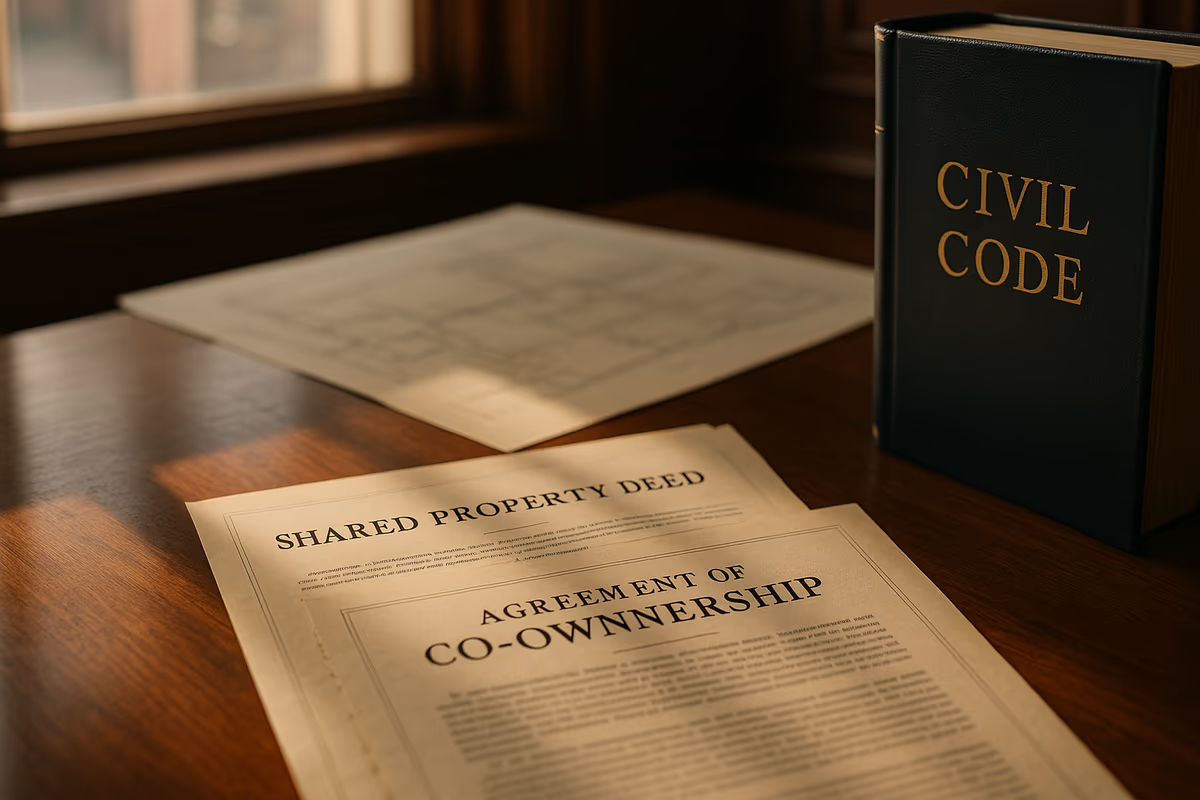

Buying a flat as an unmarried couple, a property inheritance shared between brothers and sisters, a jointly owned house after a divorce: in all these cases, several people find themselves owners of the same property without any of them being able to dispose of it alone. This is joint ownership (indivision), a regime that many people endure rather than choose, and whose deadlocks feed a significant share of property litigation. This FAQ sets out what the French Civil Code provides in 2026: how the management of jointly owned property works, who decides what, how to leave joint ownership and how to organise the partition of jointly owned property when the joint owners disagree.
What is joint ownership (indivision) and where does it come from?
Joint ownership designates the legal situation in which two or more persons together hold rights of the same nature over the same property, without their shares being physically divided. Each person holds an abstract share (a third, a half, an eighth) in the whole of the property, and not an identified part of it. Two cohabiting partners who buy a house in equal shares each hold an undivided half of the whole, not one bedroom each.
The regime of joint ownership is set out in Articles 815 et seq. of the French Civil Code, in the wording resulting from Law No. 2006-728 of 23 June 2006 reforming succession and gifts, supplemented by Law No. 2009-526 of 12 May 2009. These provisions remain the applicable foundation in 2026.
Joint ownership arises mainly from three situations. The first concerns succession: on a person's death, the heirs become joint owners of all the assets of the estate until partition. The second results from a joint purchase, frequent among unmarried couples (cohabitees or partners in a civil partnership (PACS) under the regime of separate property). The third stems from the dissolution of a matrimonial property regime: after a divorce, the former spouses often remain in joint ownership of the home until it is wound up. The choice between joint ownership and separate property for civil partners who buy together is examined in our article on the PACS and buying property.
Statutory joint ownership and contractual joint ownership
The French Civil Code distinguishes statutory joint ownership, which applies by default, from contractual joint ownership, organised by the joint owners themselves under Articles 1873-1 to 1873-18. The joint ownership agreement (convention d'indivision) makes it possible to adapt the management rules, appoint a manager and provide for a term. Where concluded for a fixed term, it may not exceed five years, but it is renewable (Article 1873-3). During that term, partition may in principle be sought only for a good reason. Where concluded for an indefinite term, it leaves each joint owner free to request partition at any time.
What are each joint owner's rights over the property?
Each joint owner has rights over the property proportionate to his or her share, but the exercise of those rights is framed so as to preserve those of the others.
Article 815-9 of the French Civil Code sets out the principle: each joint owner may use and enjoy the jointly owned property in accordance with its purpose, to the extent compatible with the rights of the other joint owners. In practical terms, an heir may live in the jointly owned family home, but may not deprive his or her co-heirs of it for any length of time without compensation.
Article 815-9, paragraph 2: "A joint owner who has the exclusive use or enjoyment of the jointly owned property is, unless otherwise agreed, liable to pay an indemnity."
This occupation indemnity is one of the most contentious subjects in joint ownership. Where a former spouse keeps the home alone after the separation, or where an heir moves into the family home, the other joint owners may claim an indemnity corresponding to the rental value of the property, in proportion to their rights. This indemnity forms part of the accounts of the joint ownership and will be taken into account on partition.
The fruits and income of the jointly owned property, for example the rent from a let flat, accrue to the joint ownership under Article 815-10. They are shared between the joint owners in proportion to their rights, after deduction of charges. Symmetrically, each joint owner who has incurred expenses to preserve the property or carried out improvements may claim reimbursement on partition, on the basis of Article 815-13.
Who decides what? The rules for managing jointly owned property
The management of joint ownership rests on a system of majorities graded according to the importance of the act. This is the practical core of what the Civil Code says about joint ownership.
Acts of preservation: each joint owner alone
Article 815-2 authorises any joint owner to take alone the measures necessary to preserve the jointly owned property, even if they are not urgent. Redoing a roof that threatens to collapse, paying an insurance premium, interrupting a limitation period: these acts may be carried out by a single joint owner, who may then claim reimbursement of the others' share.
Acts of administration: a two-thirds majority
Article 815-3 allows joint owners holding at least two thirds of the joint rights to carry out acts of administration by that majority. This two-thirds majority is calculated on rights, not on the number of heads: three brothers inheriting in equal shares each represent one third, and two out of three are therefore needed to reach the threshold.
By this majority, the joint owners may in particular:
- give one of them or a third party a general mandate of administration
- sell jointly owned movable property to pay the debts and charges of the joint ownership
- enter into and renew leases other than those relating to a property used for agricultural, commercial, industrial or craft purposes
Decisions taken by a two-thirds majority must be brought to the attention of the minority joint owners. Failing that, they cannot be enforced against them.
Acts of disposal: unanimity
The sale of the jointly owned property, the grant of a commercial lease or the creation of a mortgage are acts of disposal. Article 815-3, paragraph 3, requires the consent of all the joint owners for these acts. A single objector is therefore in principle enough to block a sale. It is this unanimity rule that creates most deadlocks, when a joint owner refuses to sell for sentimental or strategic reasons or through simple inertia.
Forced sale by a two-thirds majority
To unblock these situations, the Law of 12 May 2009 introduced Article 815-5-1, which allows a sale by a two-thirds majority under the supervision of the court. The joint owners holding at least two thirds of the rights state their intention to sell before a notary. The notary serves this intention on the other joint owners. If one of them objects or does not reply within three months, the notary draws up a record, and the judicial court (tribunal judiciaire) may authorise the sale by auction (licitation) if it does not cause excessive harm to the rights of the minority joint owners.
This mechanism has important limits. It does not apply where the joint ownership is dismembered, that is, where a usufruct and a bare ownership coexist, nor where one of the joint owners is a minor or an adult under legal protection. In those cases, the sale remains subject to specific protective rules.
How to leave joint ownership?
The question of how to leave joint ownership is probably the one most often asked, because this regime is by nature precarious and conflict-prone. The Civil Code lays down a fundamental principle in Article 815.
Article 815: "No one may be compelled to remain in joint ownership and partition may always be sought, unless it has been stayed by judgment or agreement."
This principle means that no joint owner can be a prisoner of joint ownership against his or her will. There are several ways out. This principle and the exceptions that allow joint ownership to be maintained are developed in our article entitled "No one is bound to remain in joint ownership".
Transfer of one's share
A joint owner may sell or give away his or her undivided share. If it is transferred for consideration to a person outside the joint ownership, the other joint owners benefit from a right of pre-emption provided for in Article 815-14. The transferor must notify the fellow joint owners, by extrajudicial instrument, of the price and conditions of the transfer and the identity of the acquirer. The joint owners then have one month to state whether they wish to exercise their pre-emption right and buy the share at the same price. This rule prevents an unknown third party from entering the joint ownership.
Buying out shares between joint owners
The most frequent and most peaceful solution is for one of the joint owners to buy out the shares of the others. After a divorce, one of the former spouses often buys out the other's share in the home, an operation known as a buy-out with balancing payment (rachat de soulte). The property then leaves joint ownership and becomes the exclusive property of the acquirer. This operation must be formalised by a notarial deed and gives rise to payment of partition duties.
Amicable partition
Partition is the operation that ends joint ownership by allocating to each person assets corresponding to his or her share. Where all the joint owners agree and have capacity, the partition is amicable. If it concerns real property, it must be recorded in a notarial deed. Partition may be total or partial, in kind (each person receives an asset) or with payment of balancing sums (soultes) where the lots are of unequal value.
Partition has a declaratory effect, enshrined in Article 883: each co-partitioner is deemed to have owned the assets received since the opening of the joint ownership, and never to have had any right in the others. This retroactive effect has important practical consequences, in particular for the validity of acts carried out by a joint owner over an asset that is ultimately not allocated to him or her.
What to do in case of deadlock? Judicial partition of jointly owned property
Where the joint owners cannot agree, partition of the jointly owned property becomes judicial. Article 840 provides that partition is ordered by the court if one of the joint owners refuses to consent to amicable partition or if disputes arise as to the manner of carrying it out or completing it.
The procedure takes place before the judicial court, with mandatory representation by a lawyer. The judge orders partition and generally appoints a notary to carry it out. Where the property cannot conveniently be divided in kind, which is almost always the case for a single property, the court orders its sale by auction (licitation), and the price is then distributed among the joint owners.
This procedure is long, costly and uncertain as to the price obtained at auction, which is often below market value. That is why it is the last resort, to be started only after amicable negotiations have failed. A joint owner who wishes to force an exit has every interest in documenting the attempts at amicable settlement before going to court.
Forced continuation of joint ownership
The principle that no one can be compelled to remain in joint ownership has exceptions. The court may, in certain protective situations, stay partition for a maximum of two years, for example if immediate realisation risks harming the value of the assets or if one of the joint owners cannot take over the operation of a business forming part of the estate. Likewise, the surviving spouse or an heir may request preferential allocation of the family home, a mechanism that avoids a sale by allocating the property to one of the joint owners in return for a balancing payment (soulte).
Who pays the charges and debts of the joint ownership?
Each joint owner contributes to the charges and debts of the joint ownership in proportion to his or her rights. Current charges (property tax, co-ownership charges, insurance, maintenance works) must be borne by all, even by a joint owner who does not occupy the property. In practice, the person who has advanced these expenses keeps an account and claims reimbursement on partition.
The personal creditors of a joint owner are in a particular situation. Article 815-17 prohibits them from directly seizing their debtor's share in the jointly owned property. They may, however, seek partition in their debtor's name or intervene in a partition already under way. The fellow joint owners may then halt the partition action by paying the debt in place of their debtor. Conversely, the creditors of the joint ownership itself, whose debt arose from the preservation or management of the jointly owned property, may be paid out of the assets before partition. The position of the personal creditor of a joint owner who intends to seek partition in order to reach his debtor's share is the subject of a separate analysis.
The joint ownership agreement: organising rather than enduring
To avoid deadlocks, joint owners may enter into a joint ownership agreement governed by Articles 1873-1 et seq. This tool is particularly useful for unmarried couples who buy together, or for heirs who wish to keep a property without selling it immediately.
The agreement makes it possible to appoint a manager with defined powers, to set the decision-making arrangements, to allocate charges and income, and to organise the use of the property. Concluded for a fixed term within the limit of five renewable years, it suspends the possibility of requesting partition for its duration, save for a good reason. This contractual stability is valuable, but it requires careful drafting by a professional, since a poorly calibrated clause can freeze a situation that has become unfavourable.
Conclusion: anticipating is better than enduring
Joint ownership is not a regime designed to last. The Civil Code organises it as a transitional situation that each person can leave, but the majority rules, and above all the requirement of unanimity to sell, make it a ground for conflict as soon as interests diverge. Joint ownership disputes rarely turn on the law itself: they turn on a lack of anticipation. Buying a property with others without an agreement, leaving an estate in joint ownership for years without formalising the occupation accounts, is preparing a future deadlock.
The approach is clear: joint ownership is managed upstream, by a joint ownership agreement for those who want to keep the property, or by a swift partition for those who want to leave. Before any joint purchase or any acceptance of an estate that includes a building, have a notary or a lawyer quantify the consequences of leaving joint ownership, and formalise in writing the rules of management and allocation of charges. In case of established deadlock, have the strength of a claim for judicial partition assessed before starting it, because auction sales often end in a disappointing price.
Frequently asked questions
Can one be forced to remain in joint ownership?
No. Article 815 of the French Civil Code sets out the principle that no one may be compelled to remain in joint ownership and partition may always be sought. There are, however, exceptions: a fixed-term joint ownership agreement (five years at most) suspends the request for partition, and the judge may stay partition for two years in certain protective situations, for example to preserve the value of the property or to allow preferential allocation of the family home.
How can jointly owned property be sold if a single joint owner refuses?
The sale of jointly owned real property in principle requires unanimity, under Article 815-3. To overcome a refusal, the Law of 12 May 2009 created Article 815-5-1: the joint owners holding at least two thirds of the rights may state their intention to sell before a notary, who serves it on the others. In case of opposition, the judicial court may authorise the sale by auction (licitation). This mechanism applies neither in case of dismemberment (usufruct and bare ownership), nor where a joint owner is a minor or an adult under legal protection.
What is the occupation indemnity in joint ownership?
It is the sum owed to the other joint owners by the joint owner who alone occupies the jointly owned property, provided for in Article 815-9 of the French Civil Code. It corresponds in principle to the rental value of the property, calculated in proportion to the rights of the fellow joint owners. Very frequent after a divorce or a succession where a single occupant remains in the home, it forms part of the accounts of the joint ownership and is settled on partition. It may be claimed for a past period, within the limits of the limitation period.
How to leave joint ownership after a divorce?
Three routes are possible. One of the former spouses buys out the other's share by paying a balancing sum (soulte), an operation formalised by notarial deed. The former spouses sell the property to a third party and share the price. Failing agreement, one of them applies to the judicial court for judicial partition, which will most often result in a sale by auction (licitation). Winding up the post-community joint ownership requires the accounts between the former spouses to be drawn up, in particular the occupation indemnity and the reimbursement of loans paid by only one of them.
Can a creditor seize a joint owner's share?
No, not directly. Article 815-17 of the French Civil Code prohibits the personal creditors of a joint owner from seizing his or her share in the jointly owned property before partition. The creditor may, however, seek partition in the debtor's name so that the debtor's share is isolated and becomes capable of seizure. The other joint owners may then halt this action by paying the debt in place of the defaulting debtor.
How long does judicial partition of jointly owned real property take?
There is no fixed duration, but a judicial partition procedure before the judicial court, with the appointment of a notary and then possibly an auction sale, frequently extends over several years where the joint owners are in dispute. Representation by a lawyer is mandatory. This duration, the cost and the risk of a sale price below market value explain why this route is reserved for situations of total deadlock, after amicable partition has failed.
Is a notary needed to partition jointly owned property?
Yes, whenever the partition concerns real property. The amicable partition of a building must be recorded in a notarial deed to allow land registration and the transfer of ownership. The notary draws up the accounts of the joint ownership, calculates any balancing sums and collects the partition duties. In case of judicial partition, the court also appoints a notary to conduct the operations under the supervision of the judge.
Quatre questions suffisent à situer votre position, le délai qui vous reste et ce qu'il faut vérifier en priorité. Vous décidez ensuite si vous en parlez au cabinet.
Décrire ma situationA defect discovered after the sale?
The time limit for taking action runs not from the sale but from the discovery of the defect, and it is shorter than people think.


