
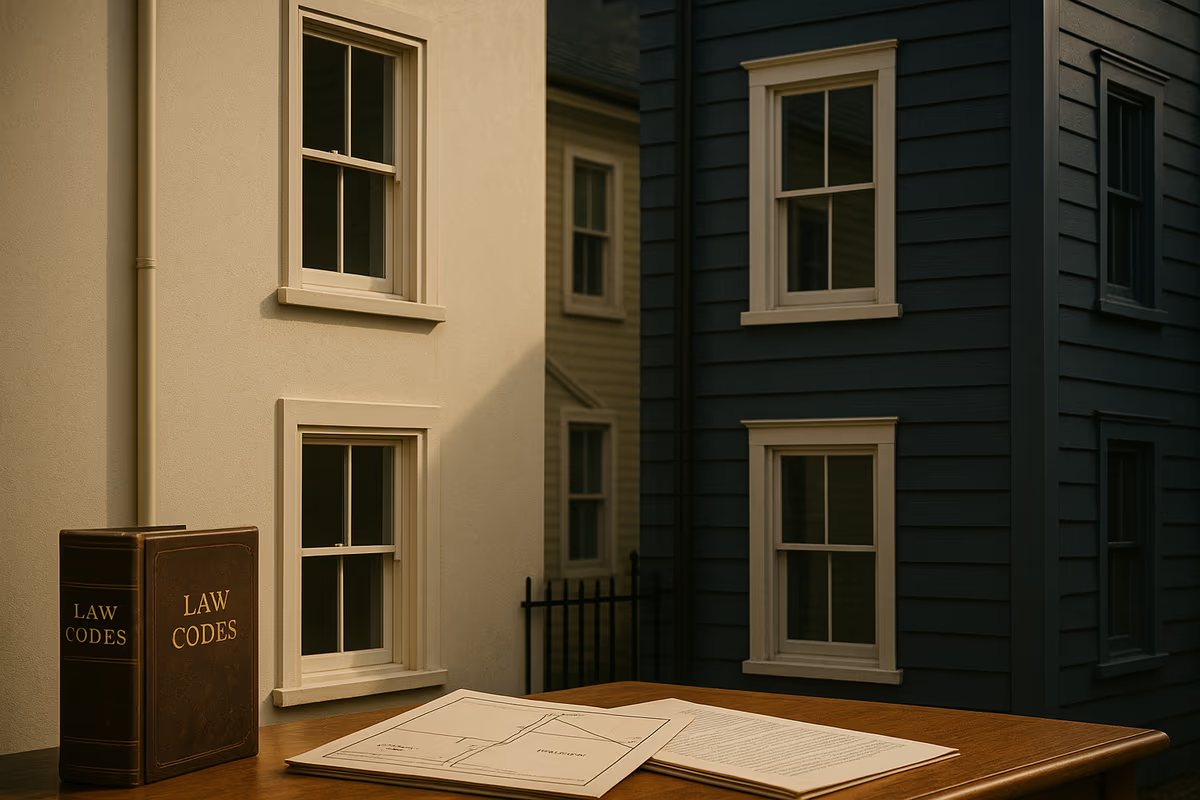

A neighbour has just installed an upstairs window looking directly onto your terrace, or built a balcony overlooking your garden. The feeling of being watched at home is one of the most frequent causes of neighbourhood disputes. The French Civil Code regulates these situations precisely through what is known as the right of view (servitude de vue), and sets minimum distances to be respected under Articles 678 and 679. This guide explains these distances, the difference between a view and a mere light opening, the cases in which an irregular opening can become lawful with the passage of time, and the practical remedies against an unlawful view.
What the right of view covers
The right of view is the right of an owner to have an opening (window, French window, balcony, terrace) allowing a view onto the neighbour's property. The Civil Code starts from a simple principle: one cannot freely create an opening that looks onto the neighbouring land without respecting minimum distances, because this view interferes with the privacy of the person who has to endure it.
Two very different regimes must be distinguished, often confused in everyday language: the light opening (jour) and the view (vue). This distinction governs the whole legal analysis.
View and light opening: a fundamental distinction
A light opening (jour) is an opening that lets light through, but not the gaze. It is known as a jour de souffrance (tolerated light opening). In practical terms, it is an opening with fixed (non-opening) translucent glass, placed high up, so that the occupant cannot look onto the neighbour's property.
A view (vue) is an opening that allows one both to see and, most often, to pass one's head or body through: a window that opens, a French window, a balcony, an accessible terrace. As soon as a person can look comfortably onto the neighbouring land, there is a view, subject to the statutory distances of Articles 678 and 679.
Take a concrete example. The owner of a town house makes, upstairs, a small fixed opening in glass blocks, 2.20 metres above the floor of the room: this is a light opening. The same owner installs an ordinary casement window at normal sill height, allowing a person to lean out: this is a view, and the distance from the boundary becomes decisive.
Direct views and oblique views
The Civil Code also distinguishes two types of view according to the direction of the gaze.
- The direct view (vue droite) is the one obtained by looking straight ahead, without having to turn the head. A window parallel to the boundary offers a direct view onto the neighbouring garden.
- The oblique view (or lateral view) is the one obtained only by turning the head to the side. A window located on a wall perpendicular to the boundary, from which the neighbouring land can be seen only by leaning sideways, offers an oblique view.
This difference is not theoretical: the statutory distance required is not the same in the two cases, the direct view being considered more intrusive than the oblique view.
The statutory distances imposed by Articles 678 and 679 of the Civil Code
The heart of the system lies in two short but essential articles. They set the minimum statutory distance between the opening and the property boundary.
The direct view: 1.90 metres
Article 678 of the French Civil Code lays down the rule for direct views:
One may not have direct views or windows overlooking, nor balconies or other similar projections, onto the enclosed or unenclosed property of one's neighbour, unless there are nineteen decimetres of distance between the wall in which they are made and that property.
Nineteen decimetres correspond to 1.90 metres. In other words, an ordinary window, a balcony or a terrace offering a direct view must be located at least 1.90 metres from the dividing line with the neighbour. This rule applies whether or not the neighbouring land is enclosed, built on or simply a garden. The question of the statutory distance for a view onto a garden is therefore resolved in the same way as for a view onto a courtyard or a building.
The oblique view: 0.60 metres
Article 679 deals with oblique views:
One may not, subject to the same reservation, have oblique or lateral views onto the same property, unless there are six decimetres of distance.
Six decimetres correspond to 0.60 metres. A lateral view, which requires turning the head to see the neighbouring land, can therefore be created at only 60 centimetres from the boundary. The difference from the direct view is explained by the less direct, and therefore less penetrating, nature of the gaze.
An example helps to visualise this. A house is built along the boundary. A window placed on the facade parallel to that boundary offers a direct view: it must respect 1.90 metres. A window placed on the gable wall perpendicular to the boundary offers an oblique view: 0.60 metres is enough. The same window, depending on the wall in which it is made, is therefore not subject to the same rule.
How the distance is measured (Article 680)
Many disputes arise from a measurement error. Article 680 of the French Civil Code specifies the starting point:
The distance referred to in the two preceding articles is counted from the outer face of the wall in which the opening is made, and, where there are balconies or other projections, from their outer line to the dividing line between the two properties.
In practical terms, one measures from the outer face of the wall (the outer facing) to the property boundary. Where there is a balcony, a projecting terrace or a landscaped roof overhang, the measurement starts from the furthest edge of the projection, not from the wall. A terrace that projects beyond the face of the facade therefore comes closer to the neighbour, and the 1.90-metre distance must be respected from the edge of the terrace.
This precision is decisive: a balcony may appear compliant if measured from the wall, but become irregular once the projection is taken into account. For an unlawful view from a neighbour, the first check is always to identify the correct measuring point.
Tolerated light openings: a regulated tolerance
Where an owner cannot respect the distances for views but still wants to let light in, he or she may create a tolerated light opening (jour de souffrance). Articles 676 and 677 of the French Civil Code set strict conditions for this.
Article 676 requires that the light opening be made of fixed glass, that is a fixed opening that cannot be opened, fitted with a fixed-glass frame. Article 677 sets the minimum height of the light opening above the floor of the room it lights:
- 2.60 metres on the ground floor (twenty-six decimetres);
- 1.90 metres on the upper floors (nineteen decimetres).
These heights ensure that the occupant cannot see into the neighbour's property, but only receive light. A tolerated light opening confers no acquired right: the neighbour retains the ability to build on his or her side and to block it, unless a right of view has been validly established.
The classic mistake is to turn a light opening into a view. An owner who replaces fixed glass blocks with an opening window, or who lowers the sill of an opening in order to lean out, creates a view and again falls under the distances of Articles 678 and 679. The neighbour may then demand that it be brought back into compliance.
When a view becomes lawful despite the distance
An opening that does not respect the statutory distances is not automatically condemned. The law recognises two bases allowing a right of view to become regular: title and prescription. This is a point often overlooked, which can completely reverse the outcome of a dispute.
The right acquired by thirty-year prescription
The right of view is a continuous and apparent easement within the meaning of Article 690 of the French Civil Code. As such, it may be acquired by prescription, that is by the passage of time. The period is thirty years.
In practical terms, if a window offering a direct view has existed for more than thirty years at less than 1.90 metres from the boundary, without interruption or objection, the owner may have acquired a right of view by prescription. The neighbour can then no longer demand the removal of the opening, even if it never respected the statutory distance.
The starting point of the period is important. The case law considers that prescription runs from the creation of the opening, provided it is apparent and actually allows a view. For a tolerated light opening, however, prescription does not operate in the same way, because a light opening creates no right for the person who benefits from it: the neighbour can block it at any time by building.
Take an example. An old house has had, for several decades, an upstairs window looking at 1.50 metres onto the neighbouring garden. The new owner of the neighbouring land discovers this view and demands its removal. If the opening has existed in the same state for more than thirty years, the right is probably acquired and the action is very likely to fail. The whole difficulty will lie in establishing the age of the opening, by dated photographs, old plans, witness statements or any item of evidence.
The right established by title
A right of view may also result from a title, that is a legal instrument: an agreement between neighbours, a clause in a sale deed, or a partition. It is common, when a property is divided into several lots, for the notarial deed to provide expressly for the retention of existing views, or on the contrary to prohibit them.
Before bringing any claim, careful reading of the title deeds and the history of the land is therefore essential. A properly drafted contractual easement prevails over the statutory distances of Articles 678 and 679, which are only default rules between neighbours who agree otherwise. The interaction between planning rules and contractual waiver of view distances, in a construction project, is analysed in our article on the common courtyard easement (servitude de cour commune).
What to do about an unlawful view from a neighbour
Faced with an unlawful view from a neighbour, the response must be methodical. Acting in a disorderly way, or too late, risks seeing the view regularised by prescription or needlessly aggravating the conflict.
Step 1: record the situation and gather evidence
The first step is to characterise the situation precisely. Is it a direct or an oblique view? At what exact distance from the boundary, measured in accordance with Article 680? Is the opening a view or a simple compliant tolerated light opening?
It is prudent to have a report drawn up by a commissaire de justice (bailiff, formerly huissier de justice), who will measure the distance and photograph the opening. In case of doubt about the exact boundary between the two properties, a boundary survey (bornage) carried out by a chartered land surveyor (géomètre-expert) makes it possible to fix the dividing line legally, an indispensable prerequisite for any reliable distance measurement. The choice between an amicable and a judicial boundary action is examined in our article on boundary disputes between neighbours.
The age of the opening must also be checked. If it is recent, thirty-year prescription cannot be raised against the claim, and the claimant's position is solid. If it is old, the analysis must take into account the risk of an acquired right.
Step 2: dialogue and formal notice
In the majority of cases, a direct exchange or an explanatory letter is enough to resolve the dispute, especially where the neighbour was unaware of the rule. It is useful to recall Articles 678 to 680 of the French Civil Code and to propose a solution: fitting fixed glass turning the view into a light opening, installing a fixed opaque frame, or moving the opening.
If dialogue fails, a formal notice (mise en demeure) by registered letter with acknowledgement of receipt formalises the request. Since the reform of civil procedure, an attempt at amicable resolution (conciliation, mediation or participatory procedure) is in principle a mandatory prerequisite for neighbourhood disputes relating to an easement, before any application to the court. Use of a court-appointed conciliator (conciliateur de justice), free of charge, is often the quickest route.
Step 3: legal proceedings
Failing agreement, the dispute falls to the tribunal judiciaire (judicial court), which has jurisdiction over easements and real property. The claimant generally seeks:
- removal or bringing into compliance of the opening (blocking up, fitting fixed glass, an order to respect the statutory distance);
- a daily penalty (astreinte), that is a sum payable for each day of delay to compel the neighbour to comply with the decision;
- damages in compensation for the nuisance suffered, in particular the interference with privacy and private life.
In cases of urgency or manifestly unlawful nuisance, summary proceedings (référé) make it possible to obtain an interim measure quickly, without waiting for the judgment on the merits. The summary judge may order the immediate cessation of the nuisance where the irregularity of the view is not seriously open to dispute. The conditions of référé based on manifestly unlawful nuisance are set out in our article on the référé for useful measures under Article 835 of the French Code of Civil Procedure.
The question of the time limit for acting
An owner who suffers an unlawful view has an interest in acting without delay. As long as the right has not been acquired by thirty-year prescription, he or she may request the removal of the opening. But the passage of time works against him or her: the longer he or she waits, the closer the neighbour comes to the thirty years that will regularise the situation. Passivity can therefore cost the right to act permanently.
Frequent special cases
Several situations recur regularly and deserve specific attention.
The balcony and the terrace are treated as views, because they allow a person to lean out and look onto the neighbour's property. The 1.90-metre distance is then measured from the outer edge of the projection. A terrace laid out on a flat roof, accessible and able to accommodate people, follows the same logic.
The party wall (mur mitoyen) calls for a particular rule: Article 675 of the French Civil Code prohibits one of the co-owners from making an opening in the party wall without the consent of the other. No window or light opening can be made in it unilaterally.
Openings onto the public highway are outside the distances of Articles 678 and 679, which protect only neighbouring private land. A window looking onto the street raises no problem of right of view with regard to a neighbour.
Finally, the right of view must be distinguished from abnormal neighbourhood nuisance. A view respecting the statutory distances may, in particular cases, be the source of a nuisance exceeding the normal inconveniences of neighbourhood (massive overlooking, a device deliberately encouraging visual intrusion). This basis, now enshrined in Article 1253 of the French Civil Code resulting from Law No. 2024-346 of 15 April 2024, follows a distinct regime and requires proof of the abnormal nature of the nuisance, irrespective of compliance with the view distances.
Conclusion
The logic of Articles 678 to 680 of the French Civil Code is clear: 1.90 metres for a direct view, 0.60 metres for an oblique view, measured from the outer face of the wall or the edge of the projection to the property boundary. But this apparently mechanical rule becomes more complicated as soon as the age of the opening comes into play, because even an irregular view may become untouchable after thirty years through the effect of prescription. It is this twofold dimension, statutory distances on one side, prescription and titles on the other, that decides the outcome of most disputes.
The real risk, for someone suffering an unlawful view, is not losing the case: it is waiting. Each passing year brings the neighbour closer to the thirty-year prescription that will regularise his or her opening. Before acting, have a commissaire de justice report drawn up measuring the exact distance and, in case of doubt about the boundary, have the land surveyed by a chartered land surveyor (géomètre-expert). These two documents condition the strength of any claim and make it possible to begin the amicable procedure, then the judicial one, on incontestable foundations.
Frequently asked questions
What is the statutory distance for a window looking onto the neighbour's garden? A window offering a direct view onto the neighbouring garden must respect a distance of 1.90 metres (nineteen decimetres) between the wall and the property boundary, pursuant to Article 678 of the French Civil Code. For an oblique view, obtained only by turning the head, the distance falls to 0.60 metres under Article 679. The distance is measured from the outer face of the wall, or from the edge of a projecting balcony, to the dividing line.
What is the difference between a view and a tolerated light opening? A view allows a person to see and lean out onto the neighbour's property; it is subject to the statutory distances of 1.90 metres or 0.60 metres. A tolerated light opening lets in only light: it must be of fixed translucent glass, placed 2.60 metres above the floor on the ground floor and 1.90 metres on the upper floors (Articles 676 and 677 of the French Civil Code). A light opening creates no acquired right and can be blocked by the neighbour who builds.
Can a neighbour be required to remove a window that is too close? Yes, as long as the right of view has not been acquired by prescription. If the opening does not respect the statutory distance and has existed for less than thirty years, the neighbour may be ordered by the tribunal judiciaire to remove it or bring it into compliance, subject to a daily penalty, and to pay damages. An attempt at amicable resolution is in principle mandatory before applying to the judge.
After how long does an unlawful view become lawful? As the right of view is continuous and apparent, it may be acquired by prescription after thirty years (Article 690 of the French Civil Code). After that period, even an irregular view can no longer be removed. The period runs from the creation of the opening, provided it is apparent and actually allows a view.
How is the statutory distance of a view measured? Article 680 of the French Civil Code requires counting from the outer face of the wall in which the opening is made to the boundary separating the two properties. Where there is a balcony, terrace or projection, the measurement starts from the furthest outer edge. A balcony may therefore be irregular even if the wall itself respects the distance.
Do the view distances apply to a balcony or terrace? Yes. Balconies, accessible terraces and other projections allowing a person to look onto the neighbour's property are treated as views and must respect 1.90 metres for a direct view, measured from the edge of the projection. This is one of the points most often overlooked when carrying out extension works or creating a terrace.
Is a lawyer needed for a right-of-view dispute? The attempt at conciliation, free of charge and often effective, does not require a lawyer. By contrast, as soon as an action is brought before the tribunal judiciaire, in particular where the question of prescription or of an easement by title arises, the assistance of a lawyer is strongly recommended, or even mandatory depending on the amount and nature of the claims. Advice at an early stage also makes it possible to assess the chances of success before incurring costs.
Quatre questions suffisent à situer votre position, le délai qui vous reste et ce qu'il faut vérifier en priorité. Vous décidez ensuite si vous en parlez au cabinet.
Décrire ma situationA defect discovered after the sale?
The time limit for taking action runs not from the sale but from the discovery of the defect, and it is shorter than people think.


